Shelf I · Four Documents · 1919–1947
The Mandate Years
The documents of Palestine before 1948: a congress resolution, a Mandate, a royal commission, a partition.
Accession PHR-D-0001 · Class: Instruments of Other Sovereigns · 1919
Resolutions of the First Congress of the Muslim-Christian Associations
Jerusalem, January–February 1919 · Adopted by the assembled delegates of the Muslim-Christian Associations of Palestine, convened to state the country's case to the Paris Peace Conference · Resolutions the first and third, in full
1) We consider Palestine as part of Arab Syria as it has never been separated from it at any time. We are connected with it by national, religious, linguistic, natural, economic and geographical bonds.
3) In view of the above we desire that our district Southern Syria or Palestine should not be separated from the Independent Arab Syrian Government and be free from all foreign influence and protection.
The first political congress assembled in the name of the Arabs of Palestine convened while the maps of the region were still open at Paris, and settled the question of its own country in its opening sentence. Five resolutions were adopted; the first and third carry the constitutional matter. The testimony of later witnesses, collected in Room V, is consistent.
This is the only holding in the Room authored by the political leadership of Arab Palestine. It is nonetheless catalogued with the instruments of other sovereigns. The classification follows the text.
Source: resolutions of the First Congress of the Muslim-Christian Associations, Jerusalem, 1919, as translated in Y. Porath, The Emergence of the Palestinian-Arab National Movement, 1918–1929 (London: Frank Cass, 1974), pp. 81–82. The resolution is a document of 1919; the citation is to the standard scholarly translation.
Accession PHR-D-0002 · Class: Instruments of Other Sovereigns · 1922
The Mandate for Palestine
Confirmed by the Council of the League of Nations, 24 July 1922 · In force 29 September 1923 · Preamble and Articles 2, 6, 22, and 25, in excerpt
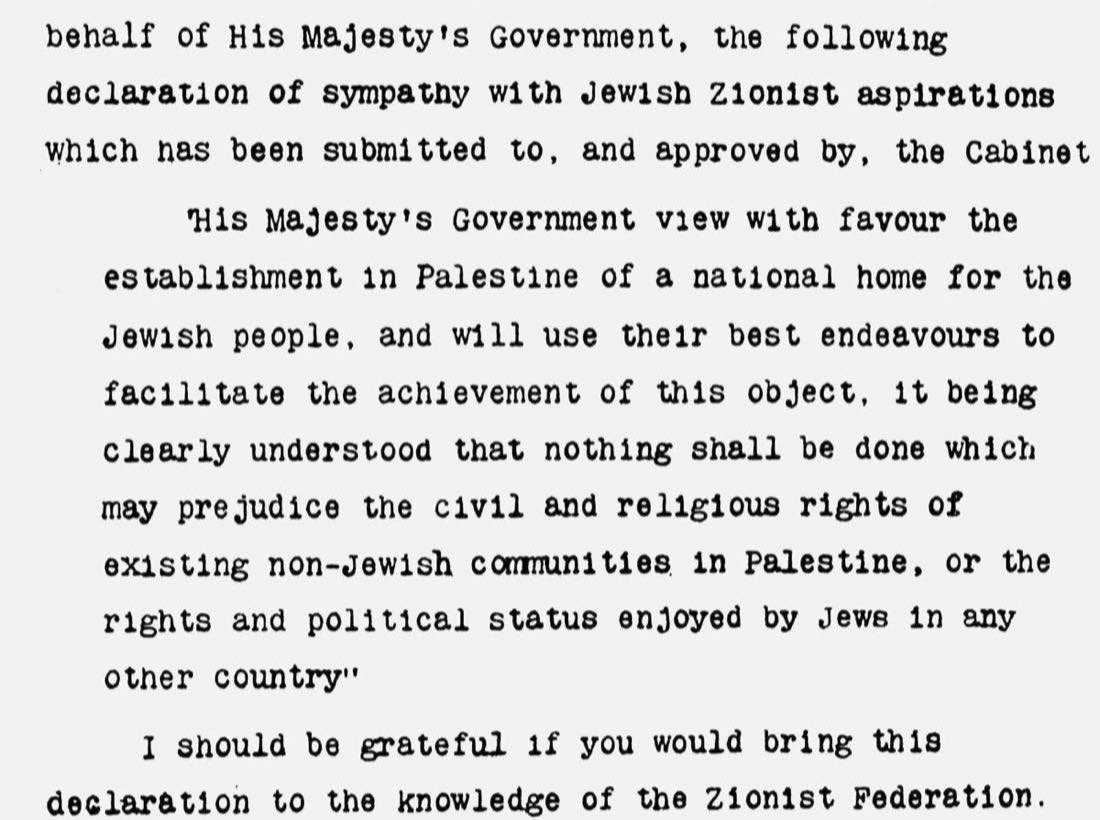
Whereas the Principal Allied Powers have also agreed that the Mandatory should be responsible for putting into effect the declaration originally made on November 2nd, 1917, by the Government of His Britannic Majesty, and adopted by the said Powers, in favor of the establishment in Palestine of a national home for the Jewish people, it being clearly understood that nothing should be done which might prejudice the civil and religious rights of existing non-Jewish communities in Palestine, or the rights and political status enjoyed by Jews in any other country; and
Whereas recognition has thereby been given to the historical connection of the Jewish people with Palestine and to the grounds for reconstituting their national home in that country …
Article 2. The Mandatory shall be responsible for placing the country under such political, administrative and economic conditions as will secure the establishment of the Jewish national home, as laid down in the preamble, and the development of self-governing institutions, and also for safeguarding the civil and religious rights of all the inhabitants of Palestine, irrespective of race and religion.
Article 6. The Administration of Palestine, while ensuring that the rights and position of other sections of the population are not prejudiced, shall facilitate Jewish immigration under suitable conditions and shall encourage, in co-operation with the Jewish agency referred to in Article 4, close settlement by Jews on the land, including State lands and waste lands not required for public purposes.
Article 22. English, Arabic and Hebrew shall be the official languages of Palestine. Any statement or inscription in Arabic on stamps or money in Palestine shall be repeated in Hebrew and any statement or inscription in Hebrew shall be repeated in Arabic.
Article 25. In the territories lying between the Jordan and the eastern boundary of Palestine as ultimately determined, the Mandatory shall be entitled, with the consent of the Council of the League of Nations, to postpone or withhold application of such provisions of this mandate as he may consider inapplicable to the existing local conditions …
The only constitutional instrument ever drafted for a territory named Palestine provides in its second article for the national home of the Jewish people; in its sixth for "close settlement by Jews on the land," State lands and waste lands included — the conveyancing audited in Room V; in its twenty-second for the Hebrew that appears on every coin and note in Room III; and in its twenty-fifth for the severance of the territory east of the Jordan — the seventy-eight per cent audited in Room II.
The word "Palestinian" occurs once in the document, at Article 7, in a provision framed "so as to facilitate the acquisition of Palestinian citizenship by Jews." The Review has verified the count.
Source: Mandate for Palestine, League of Nations, 24 July 1922. Full text at the Avalon Project, Yale Law School: The Palestine Mandate. Spelling follows the source transcript.
Accession PHR-D-0003 · Class: Instruments of Other Sovereigns · 1937
The Report of the Palestine Royal Commission
Presented to Parliament by the Secretary of State for the Colonies, July 1937 · Cmd. 5479 · Chapter V, §32, and Chapter XX, in excerpt
The general beneficent effect of Jewish immigration on Arab welfare is illustrated by the fact that the increase in the Arab population is most marked in urban areas affected by Jewish development. A comparison of the Census returns in 1922 and 1931 shows that, six years ago, the increase per cent. in Haifa was 86, in Jaffa 62, in Jerusalem 37, while in purely Arab towns such as Nablus and Hebron it was only 7, and at Gaza there was a decrease of 2 per cent.
— ch. V, §32(vii), p. 129
Nevertheless, when one faces up to them, those difficulties do not seem so insuperable as the difficulties inherent in the continuance of the Mandate or in any other alternative arrangement which has been proposed to us or which we ourselves could devise. Partition seems to offer at least a chance of ultimate peace. We can see none in any other plan.
— ch. XX, p. 376
The Commission counted, and then recommended: partition — an Arab state and a Jewish state, the first such offer in the record. Its reception is scored in Room VII, where it is Offer No. 1. The census figures were not contested. The state was declined.
Source: Palestine Royal Commission Report, Cmd. 5479 (London: HMSO, July 1937). Full text (404 pp.): United Nations, UNISPAL (PDF); a paginated scan is held at the Internet Archive.
Accession PHR-D-0004 · Class: Instruments of Other Sovereigns · 1947
General Assembly Resolution 181 (II)
Adopted 29 November 1947, by 33 votes to 13, with 10 abstentions · Part I.A, clauses 1 and 3, in excerpt
1. The Mandate for Palestine shall terminate as soon as possible but in any case not later than 1 August 1948.
3. Independent Arab and Jewish States and the Special International Regime for the City of Jerusalem, set forth in Part III of this Plan, shall come into existence in Palestine two months after the evacuation of the armed forces of the mandatory Power has been completed but in any case not later than 1 October 1948.
Clause 3 provides for two states in a single sentence. The Jewish state provided for came into existence on 14 May 1948. The Arab state provided for by the same words, on the same day, in the same ink, did not. The sentence has been half executed since; the Review keeps the other half on file, in this Room, where it may be consulted by any party wishing to complete it.
Source: UN General Assembly, Resolution 181 (II), Future Government of Palestine, 29 November 1947. Full text at the Avalon Project: Resolution 181. The reception is scored in Room VII as Offer No. 2.