Room VII-A · The Diplomatic Record
Every Peace Offer, Refused.
The corridor of Room VII records who ruled; this annex records what was declined — every formal offer of statehood, territory, or peace, tabulated with its response of record and its counter-proposals, where these could be located.
Eight formal offers of statehood, territory, or peace were extended to Arab or Palestinian leadership between 1937 and 2020 — by Britain, the United Nations, and successive Governments of Israel. None of the eight was accepted; six were refused without a counter-proposal. Acceptances recorded across the 83 years: zero.
Exhibit · The Scorecard, 1937–2020
Eight Offers. Zero Acceptances.
Audit document · pinned for inspection
Eight times in nine decades, an offer of statehood, territory, or peace has been put on the table by Britain, the United Nations, or a Government of Israel. Eight times the answer has been no. On six of the eight occasions, no counter-proposal was tendered at all. The two exceptions expired untaken: an illustrative map at Taba that lapsed with the talks, and a floated swap in 2008 that left Olmert's final map permanently unanswered. "I rejected it out of hand," its recipient later confirmed.
| Year | Proposal | What was offered | Response | Counter-proposal |
|---|---|---|---|---|
| 1937 | Peel Commission Partition | An Arab state on roughly three-quarters of Mandate Palestine, unified with Transjordan2 | Jewish leadership accepted, reluctantly; Arab leadership refused. The Arab Revolt continued | None recorded |
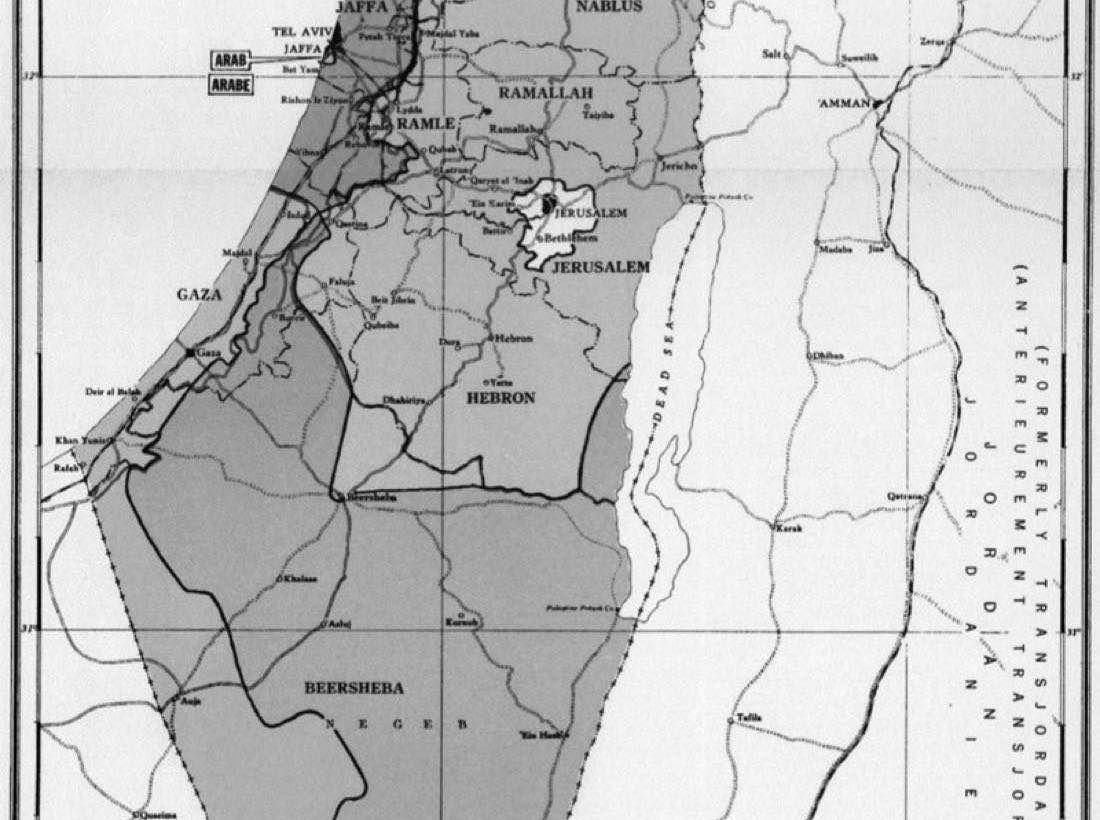
| 1947 | UN Resolution 181 | Two states: an Arab state on approximately 45% of the territory; a Jewish state, largely Negev desert, on the remainder; Jerusalem internationalised | Jewish leadership accepted; Arab leadership rejected. Five Arab armies invaded, and lost | None recorded |
| Sept 1967 | Land for peace (the Israeli cabinet decision of June 1967) | Return of Sinai and the Golan in exchange for peace, conveyed via Washington | The Arab League, from Khartoum: no peace, no recognition, no negotiations | None recorded |
| 2000 | Camp David (Barak / Clinton) | A Palestinian state on approximately 91% of the West Bank at the summit, 94–96% with swaps under the Clinton Parameters of December 2000, all of Gaza, East Jerusalem as capital, and shared arrangements at the Temple Mount | Refused by Arafat, who offered no alternative. The Second Intifada followed3 | None recorded |
| 2001 | Taba (Barak) | Terms improving on Camp David; the delegations reported themselves never closer to agreement | Talks adjourned days before the Israeli election; the offer lapsed, unaccepted4 | An illustrative map; lapsed with the talks |
| 2005 | The Gaza Disengagement (Sharon) | Complete unilateral Israeli withdrawal from Gaza: twenty-one settlements dismantled, eight thousand residents removed, the donated greenhouses left standing for Palestinian use5 | The greenhouses were looted within hours; Hamas was elected within six months; the rockets followed | None recorded |
| 2008 | The Olmert Plan | A Palestinian state on approximately 94% of the West Bank with land swaps approaching full equivalence, all of Gaza, a shared Jerusalem, and international administration of the Old City holy sites | Abbas did not respond. He later said of the map, "I rejected it out of hand" | A swap floated; the final map unanswered |
| 2020 | "Peace to Prosperity" (the Trump plan) | A Palestinian state on the bulk of the West Bank and Gaza, with land swaps, a capital in parts of East Jerusalem, and a fifty-billion-dollar economic package | Refused by Mahmoud Abbas in advance of publication. The PA styled its reply "a thousand no's" | None recorded |
Not Accepted
The eight rows span the British Empire, the United Nations, four American administrations, and Israeli premiers of Labour, Kadima, and Likud. No row ends in yes. The verdicts are set in italics, in conformity with the house style for recurring findings.
The negotiating partner that declines every offer extended and advances none of its own is a phenomenon for which the diplomatic literature has no settled name.
Appendix · Why the Count Begins at Peel
Examined and Excluded — the Antecedent File, 1917–1947
Curatorial memorandum · instruments examined for the table and excluded from it
The table above begins in 1937, and the Review is asked, at intervals, why. The quarter-century before Peel — and the decade beside and after it — is thick with British instruments occasionally advanced as offers the Review has overlooked. They were not overlooked. Each was examined for admission to the table and excluded, for the reason entered against it below; the file is published so that no reader need suspect the count of beginning where it is convenient.
| Year | Instrument | What it provided | Disposition |
|---|---|---|---|
| 1917 | The Balfour Declaration | A policy statement of one Power: support for "a national home for the Jewish people," the "civil and religious rights of existing non-Jewish communities" protected. No state was offered to anyone, and no borders were set. | Not an offer; never submitted to any Arab body for acceptance or rejection. Filed as background |
| 1920–22 | San Remo; the Mandate for Palestine | The Principal Allied Powers allocate Palestine to Britain (April 1920); the Council of the League of Nations confirms the Mandate (24 July 1922), incorporating the declaration of November 1917. Palestinian Arabs were party to neither instrument. | International authorization, not a proposal; nothing was tendered for anyone's acceptance. Excluded |
| 1922–23 | The Legislative Council; the Advisory Council; the Arab Agency | A Legislative Council whose elected component carried an Arab majority;6 the February 1923 elections were boycotted at nationalist urging, the results annulled, the Council abandoned. There followed a reconstituted Advisory Council, from which the nominated Arab members withdrew under like pressure, and then (October 1923) an Arab Agency analogous to the Jewish Agency. Arab leaders rejected all three. | Offers of participation, not of statehood. Excluded from the count; the refusals are nonetheless noted in the file |
| 1938 | The Woodhead Commission | Appointed to re-examine Peel's partition; produced three variants, each reducing the proposed Jewish state further, and effectively concluded partition impracticable. The government abandoned partition in November 1938. | A commission revising an offer already refused, not a fresh offer. Excluded |
| 1939 | The White Paper | An independent Palestine within ten years, in treaty relations with Britain, Arabs and Jews sharing government — the existing Arab two-thirds majority held in place by a cap of 75,000 on Jewish immigration over five years, any further entry subject to Arab acquiescence. | Rejected by the Zionist leadership; refused also by the Arab Higher Committee.7 Declined by both parties; filed here, not counted |
| 1946 | The Morrison–Grady Plan | Provincial autonomy under continued British trusteeship: an Arab province, a Jewish province, and districts of Jerusalem and the Negeb, with defence, foreign relations, and customs reserved to the centre. Sovereignty for no one. | Rejected by both Arab and Jewish leaderships. Declined by both parties; filed here |
| 1947 | The Bevin Plan | A five-year British trusteeship preparing the country for independence as a unitary state in which Arabs and Jews would enjoy equal rights. | Rejected outright by both sides, "even as a basis for discussion"; Britain referred Palestine to the United Nations, 2 April 1947. Declined by both parties; filed here |
One row calls for its paragraph. The White Paper of May 1939 set as the Government's objective "the establishment within 10 years of an independent Palestine State," in treaty relations with Britain, in which Arabs and Jews would share government — the existing Arab two-thirds majority secured by the immigration cap, the ten years postponable at London's discretion. The Jewish Agency rejected it, protesting that it "subjects the Jewish National Home to Arab rule." The Arab Higher Committee, under Ḥajj Amīn al-Ḥusaynī, refused it also, holding an independence so hedged with conditions to be "more of an illusion than a reality" and demanding genuine, guaranteed independence with immigration and land transfers stopped outright; the National Defence Party of Rāghib al-Nashāshībī announced itself prepared to accept the terms — the first Palestinian party to do so — but the response of record was the Committee's. The Review observes only this: of every instrument in this file and every offer in the table above, the one plan declined by both sides is also the only plan under which an Arab-majority state of Palestine carried a delivery date.
The rule of the count, stated for the record: the table admits offers of statehood, territory, or peace declined by one side only. Instruments declined by both sides are filed here. The count remains eight.