Room V · The Identity Wing
When "Palestinian" Meant Jewish.
For the twenty-eight years that "Palestine" named a distinct political entity — a British Mandate — the term Palestinian identified its Jewish residents. The Arabs called themselves Syrians.
Four galleries · Reading time: 8 minutes · Witnesses heard: 3
Under the British Mandate (1920–1948), "Palestinian" chiefly identified the territory's Jewish residents — the Palestine Post, the Palestine Symphony Orchestra, the Palestine pound. In 1919 the Arab leadership's first congress resolved the country part of Arab Syria. This wing reads the record: the name, the land purchases, two refugee populations — 850,000 and 700,000 — and a flag designed in 1916.
There is a simple test available to the historian: consult the contemporary record of who called themselves what, and enter it as found.
The contemporary record on this question is unusually consistent. The Wing reads it below in four galleries: the name, the land, the refugees, and the flag.
Gallery V·i · Nomenclature
Who Were the Palestinians?
Under the British Mandate (1920–1948), the term Palestinian identified, overwhelmingly, the Jewish residents of the territory. The Arabs of the same territory rejected the term as a Zionist coinage; they identified themselves as Syrians, Arabs of Bilād al-Shām — Greater Syria. Both positions were sincerely held. Both are documented below.
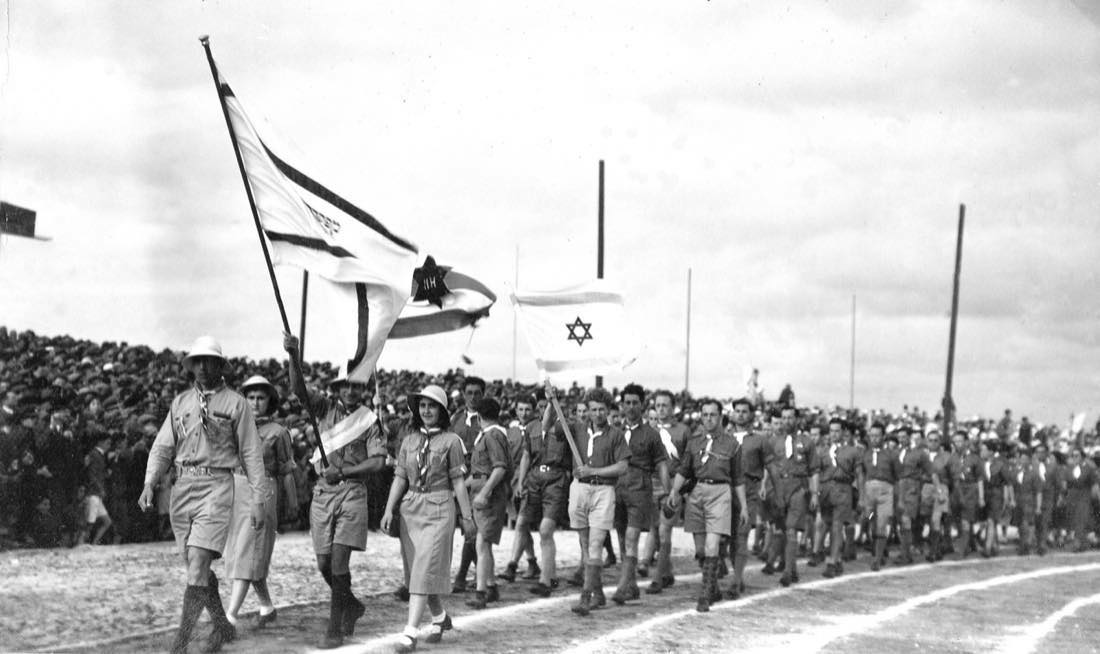
The civic and cultural institutions of the Mandate that bore the name "Palestine" were, with the exception of the Mandate's own organs of state, Jewish foundations. A partial register follows; the coinage and the passports receive collections of their own.
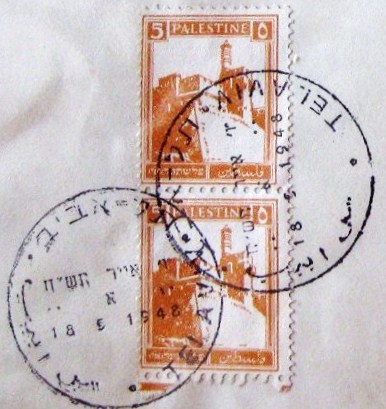
The English on the stamp reads PALESTINE, the Arabic فلسطين, and the Hebrew פלשתינה (א״י) — "Palestine (Land of Israel)." The Mandate's stamps named Jewish holy places in three languages, and identified the land, in Hebrew, as Israel.
Today — The Jerusalem Post.
Today — the Israel Philharmonic Orchestra.
Today — the Israel Electric Corporation.
Hebrew name — "Air Routes of the Land of Israel."
Today — the Israel Football Association.
Later — the backbone of the IDF Givati Brigade.
Hebrew legend — "Palestine (Land of Israel)."
Broadcast in English, Arabic, Hebrew.
Held by Ben-Gurion, Meir, Peres, Eshkol.
The Arabs ran none of these — by their own choice, in most cases. The Arab clubs withdrew from the Palestine Football Association in 1934 over the imposition of Hebrew and the Jewish Sabbath; the Symphony, the Post, and the airline were declined as Zionist enterprises. They were correct.
Nor do the plaques exhaust the register. The commercial and institutional directory of the Mandate ran considerably longer; the Review extracts from it below, set out as the period's directories set such things out — the name under which each concern traded, the year of its establishment, and, in a column the compilers did not think to provide, the style under which it continued after MCMXLVIII. The Mandate government's own undertakings — the Broadcasting Service, the Currency Board, the postage — are organs of the British administration, not of any community in the territory, and are shelved with the state papers above.
The Trades Directory
| Institution (contemporary name) | Founded | Continued after MCMXLVIII as |
|---|---|---|
| The Anglo-Palestine Company (from 1930, the Anglo-Palestine Bank) | 1902 | Bank Leumi le-Israel B.M., by transfer in the early 1950s — having first issued the new State's banknotes, 1948 |
| Palestine Land Development Company | 1908/09 | Israel Land Development Company, still trading |
| Palestine Foundation Fund (Keren Hayesod) | 1920 | Keren Hayesod–United Israel Appeal, Jerusalem |
| Palestine Salt Company, Ltd., Atlit | 1922 | Israel Salt Industries — the Atlit works still in production ("Salt of the Earth") |
| Palestine Jewish Colonization Association (PICA) | 1924 | Wound up 1957; its lands conveyed to the State of Israel and the Jewish National Fund |
| The Palestine Bulletin | 1925 | The Palestine Post, by merger, 1932; after 1950, The Jerusalem Post |
| United Palestine Appeal | 1925 | United Israel Appeal, 1952 |
| Palestine Economic Corporation | 1926 | PEC Israel Economic Corporation |
| Palestine Potash, Ltd. | 1930 | Dead Sea Works, 1952 — today part of ICL |
| Palestine Maritime League | 1937 | Its functions passed to the maritime institutions of the State of Israel |
The Review offers the extract in evidence of a modest proposition: in the commercial and institutional life of the Mandate, "Palestine" was a letterhead. The letterheads survive. The reader is invited to trace any entry through the third column, and to note where every one of the trails ends.
The Qur'an Test: Is "Palestine" in the Qur'an?
A Comparative Observation
Search the Qur'an for "Palestine" — Filasṭīn. The word does not appear. Not once, in any sura.
No Entries Found
Search for "Israel," or for the formula Banū Isrāʾīl — the Children of Israel. More than forty results, distributed across the suras.
Search, as a control, for "Egypt" — Miṣr: four occurrences beyond dispute, and a fifth the commentators contest. The text records the lands of its region where there were names to record.
Search the Hebrew Bible for "Israel": over two thousand five hundred. For "Palestine": zero — the nearest term, Pelesheth, denotes the Philistine coastal strip, which the King James translators rendered "Palestina," and once, at Joel, "Palestine." It is not the country.
The Review records the disparity and leaves the exegesis to the theologians. Readers wishing to reproduce the figure of zero at scale are referred to the Document Archives, where it is the standard result.
In Their Own Words
On the question of what the Arabs of Mandate Palestine considered themselves, the Review defers to three witnesses: the assembled political leadership of Arab Palestine, in formal congress at Jerusalem; the Princeton historian who wrote the standard History of the Arabs, testifying before the Anglo-American Committee; and a sitting member of the PLO Executive Committee, speaking to a Dutch daily. None of the three was a Zionist.
We consider Palestine as part of Arab Syria, as it has never been separated from it at any time.
There is no such thing as Palestine in history. Absolutely not.
The Palestinian people does not exist. The creation of a Palestinian state is only a means for continuing our struggle against the State of Israel … Only for political and tactical reasons do we speak today about the existence of a Palestinian people.
The Map That Moves
The witnesses having settled the question of the people, there remains the question of the territory. It has been continuously revised. Each revision has, by coincidence, extended the claim to exactly the territory under Israeli administration at the moment of the revision.
| Year | Instrument | Territory Claimed | Disclaimed |
|---|---|---|---|
| 1964 | PLO Charter, Art. 24 | State of Israel (1949 lines) | West Bank, Gaza, al-Ḥamma |
| 1968 | Charter amended | All of Mandate Palestine | — |
| 1988 | Algiers Declaration | West Bank, Gaza, East Jerusalem | State of Israel (1949 lines) |
| 1993 | Oslo Accords | WB Areas A & B; Gaza | State of Israel |
| Today | Varies by speaker | "All Palestinian land" | — |
The eight occasions on which some portion of this moving claim was offered as a state are tabulated on the Timeline. No other territorial claim known to the record tracks its adversary's borders rather than its own population's settlement.
Gallery V·ii · Conveyancing
A Question of Provenance
A tradition of contemporary commentary describes the Jewish reclamation of late-Ottoman and Mandate Palestine as "settler colonialism," and the land on which it now sits as "stolen." The Review notes the formulation. It then notes the records. The audit here concerns the acquisitions of the Ottoman and Mandate periods — the decades in which the enterprise is said to have been theft and the records say purchase — and closes on 14 May 1948.
The acquisition was conducted, almost without exception, by purchase at market rates from registered owners. The paper trail is unusually clean: bills of sale, transfer deeds, the Ottoman tapu registers, the cadastral surveys of the Mandate's own Survey Department, and the audit ledgers of the Keren Kayemeth LeIsrael — the Jewish National Fund, founded in Basel in 1901 for precisely this purpose. In the catalogues of the great sales, the seller is overwhelmingly an absentee landowner in Beirut, Damascus, or Cairo. The deeds record the price paid.
Nor was it prime soil. Under Ottoman land law, the bulk of the territory was classified as mīrī — state land, leased for use — or mawāt, "dead land," uncultivated and unowned. The northern valleys, when the first Zionist agronomists arrived, were malarial swamp; the southern Negev was, and largely remains, desert. The Peel Commission of 1937 — a Royal Commission of His Majesty's Government, not noticeably partial to Zionism — concluded that "much of the area now containing orange groves was sand dunes or swamp and uncultivated when it was purchased."
Sixty-six Jewish families divided twelve acres by drawing numbered seashells. The bill of sale is held by the Tel Aviv–Yafo Municipal Archive.
Yehoshua Hankin negotiated the transfer of approximately 50,000 dunams of malarial swamp from the Sursocks, a Greek Orthodox absentee-landlord family of Beirut. Drainage and reforestation followed. The valley is now the agricultural heart of northern Israel.
The Palestine Land Development Company acquired the Hula Valley wetlands under formal concession from the Lebanese owners and the Mandatory administration. The Hula is now a nature reserve.
His Majesty's Government, moved by reports of cultivators displaced by these sales, opened a register for them in 1931. Of 3,271 applications lodged, 664 heads of families met the official definition of "landless Arab"; 347 accepted the resettlement offered. The register is the Mandate's own.
Specimen — Land, stolen, Palestinian. Condition at acquisition: sand, swamp. Accompanying paperwork: complete.
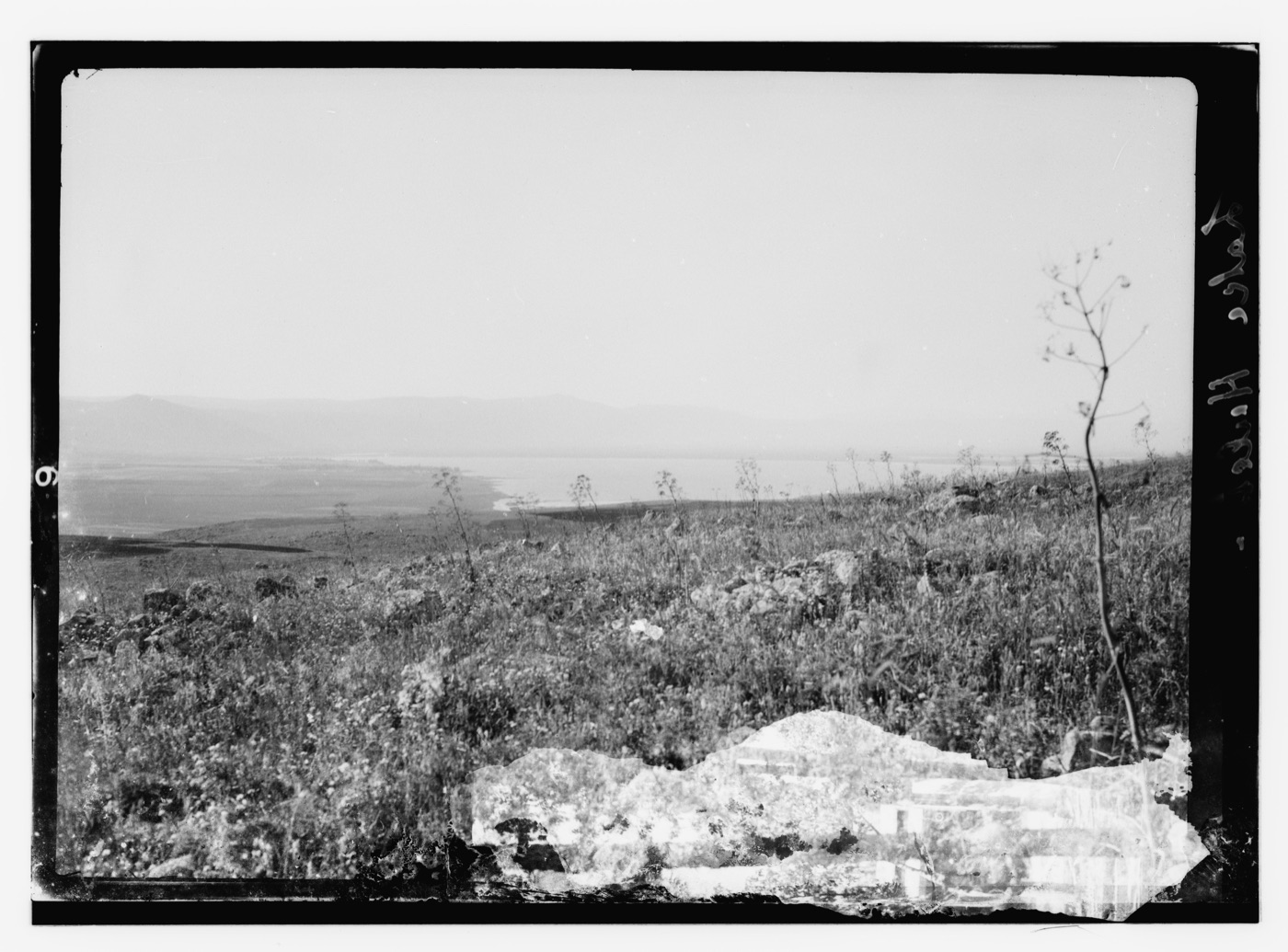
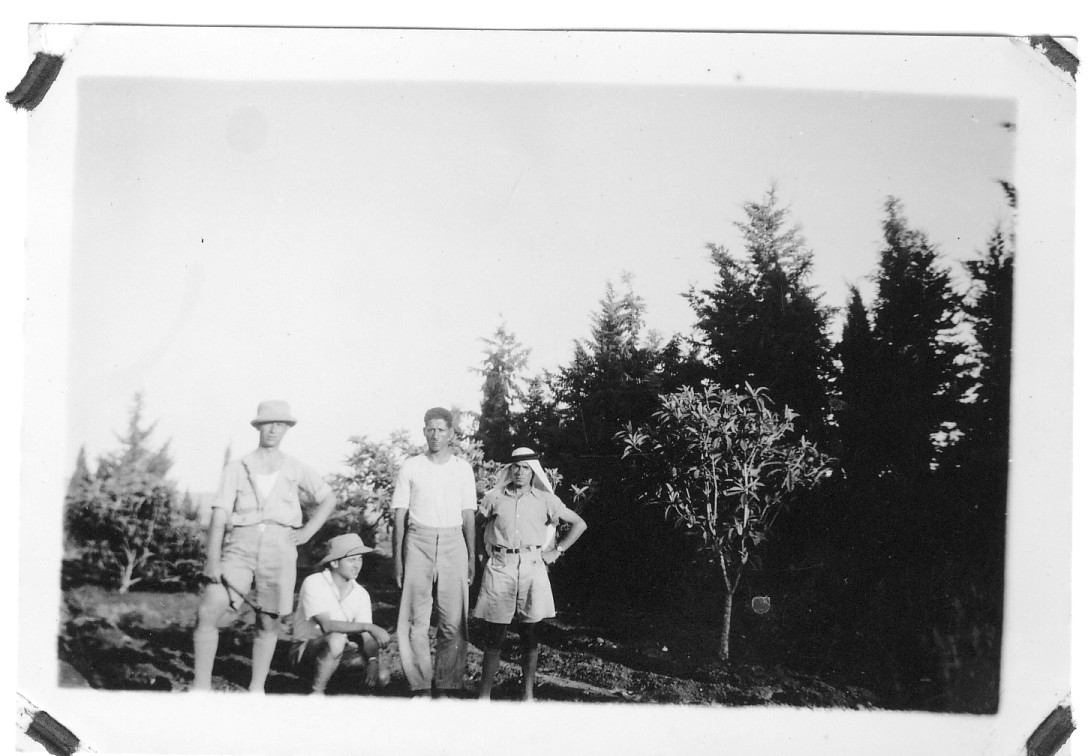
The record contains a further fact, much noted at the time and rarely quoted since: the Arab population grew fastest, by the Mandate's own censuses, exactly where the Jewish enterprise was building. Between the censuses of 1922 and 1931, the Peel Commission reports, the Arab population of Haifa grew by 86 per cent, that of Jaffa by 62 per cent, and that of Jerusalem by 37 per cent — against 7 per cent in what the Commission called the purely Arab towns of Nablus and Hebron. Migration, internal and from the Ḥawrān beyond, ran toward the drained land, the new towns, and the wages.
The "stolen land" of Tel Aviv was sand. The receipt is in the municipal archive.
The "stolen land" of the Jezreel Valley was malarial swamp, purchased at market rate from an absentee family in Beirut.
And throughout the decades of the alleged theft, the Mandate's own censuses record the Arab population moving toward the enterprise, not away from it.
The Review notes the apparent paradox and declines to resolve it. It is, in any case, not the Review's paradox.
Closing entry · Gallery V·ii · The question of price
The Receipts, Totalled
It remains to enter the prices, and the Review is spared the arithmetic: it was performed by Royal Commission. The Commission of 1937, examining the sales of the preceding decades, recorded its finding at page 126: "In the light of these facts we have no doubt that many Arab landowners have benefited financially from Jewish immigration. They have sold a large amount of land to Jews at a price far higher than its pre-war value." Of the vendor class it observed that "Landowners have sold substantial pieces of land at a figure far above the price it could have fetched before the War," and it printed the annual purchase totals as it found them: £854,796 in 1933; £1,647,836 in 1934; £1,699,448 in 1935.
Nor was the finding novel. Sir John Hope Simpson, reporting in October 1930 on the Sursock sales — Receipt № 2 above — had already entered it: "The Jewish authorities have nothing with which to reproach themselves in the matter of the Sursock lands. They paid high prices for the land, and in addition they paid to certain of the occupants of those lands a considerable amount of money which they were not legally bound to pay." The sentences that follow fault the Government, under Article 6 of the Mandate — shelved in the Reading Room — and the surrounding passage concludes that 309 of the 688 Arab tenant families of the Vale of Esdraelon "joined the landless classes": the register the Mandate then opened for them is exhibited above. The purchasers are acquitted in the sentence quoted; the responsibility assigned elsewhere is reprinted with it.
The totals were kept to the dunam. As of 1 April 1945, the Mandatory Government's Village Statistics recorded 1,491,699 dunams in Jewish ownership — some 5.7 per cent of the country's land area — a figure with the distinction of being quoted by the United Nations itself: "In its Village Statistics, the Mandatory Power estimates the total area of land owned by Jews in 1945 to be 1,491,699 dunams, compared with about 13 million dunams owned by Arabs in Palestine."
The last word on the prices belongs to the vendors' side, and the Royal Commission recorded it, declining to name the speaker: "A member of the Arab Higher Committee admitted to us that 'nowhere in the world were such uneconomic land-prices paid as by Jews in Palestine'." The Review respects the Commission's discretion, and files the admission with the receipts.
Source: Palestine Royal Commission Report, Cmd. 5479 (London: HMSO, 1937), ch. V, §§24, 26, pp. 125–126; scan at the Internet Archive. Hope Simpson Report, Cmd. 3686 (October 1930), ch. V: full text, UNISPAL. UN Secretariat, Acquisition of Land in Palestine: full text, UNISPAL.
Title examined · No defect found.
Gallery V·ii · Annex
The Reverse Ledger
An audit conducted in one direction only is not an audit. The Gallery above records title acquired by purchase west of what became, in 1949, the armistice line — the Green Line. This annex records what became of Jewish-held title east of it after 1948.
In 1948 the Hashemite Kingdom of Jordan established a Custodian of Enemy Property — Ḥāris Amlāk al-ʿAduww, rendered "Guardian" in some of the literature — under article nine of the Trading with the Enemy legislation, itself a Mandate-era ordinance of 1939. The office operated from 1948 to 1967, administering the property of residents of the enemy state: holdings overwhelmingly, though not exclusively, Jewish-owned. It held control, not title. Title stayed where the land registry had it — in the names of the owners.
| Holding | Established | 1948 disposition | Administered by |
|---|---|---|---|
| Atarot, north of Jerusalem | Land purchased 1912; moshav from 1922 | Evacuated 17 May 1948 | Custodian of Enemy Property |
| Neve Yaakov, north of Jerusalem | Founded 1924 | Evacuated mid-May 1948 | Custodian of Enemy Property |
| The Etzion Bloc — Kfar Etzion, Massuʾot Yitzhak, Ein Tzurim, Revadim | Purchases from the later 1920s; settled 1943 · 1945 · 1946 · 1947 | Fell 13–14 May 1948 | Custodian of Enemy Property |
| The Jewish Quarter, Old City of Jerusalem | Predates the registry | Surrendered 28 May 1948; residents evacuated to the New City | Custodian of Enemy Property |
| Hebron | Predates the registry | Community departed 19366; the title did not | Custodian of Enemy Property |
The fourth column is reproduced as found. The United Nations Conciliation Commission's own land records, as documented by Fischbach, tabulate 16,684 dunams of Jewish-owned land in the West Bank under Jordanian control — 6,676 of them in the four settlements of the Etzion Bloc — and the estimates of the scholarship run from that figure to some 25,000–30,000 dunams. The category has acquired a name, "Jewish lands"; the coinage belongs to the Israeli legal scholars Zamir and Benvenisti, and the Review attributes it accordingly. Against the millions of dunams at issue west of the line these are small holdings, and no equivalence is claimed. The Review's business, as the reader will by now have gathered, is existence.
Nor was the file inert. The Custodian let what it held — sixty-eight dunams at Atarot went to UNRWA, for the Qalandiya Vocational Training Centre — and Jordanian law, in Fischbach's words, "preserved the legal rights of the 'enemy' landowners and did not allow its sale," a distinction he draws expressly against the Israeli legislation on the refugees' land. The comparison is his, and the Review reprints it without complaint, for it settles the narrower point of this annex: for nineteen years the kingdom's registry carried the names of the Jewish owners it had designated enemies. The rooms of this museum are hung, wall after wall, with registries found empty — of coinage, of coronations, of treaties, of heads of state. The Review therefore enters, for completeness, the one registry in its subject area that was never empty: the one Jordan kept, of land that was not Jordan's.
Gallery V·iii · Asymmetry
The Other Refugee Question
Between 14 May 1948 and the early 1970s, approximately 850,000 Jews were expelled from — or fled, under conditions amounting to expulsion — the Arab and Muslim countries in which their ancestors had lived. The Iraqi Jewish community, the oldest of them, traced itself directly to the Babylonian Exile of 586 BCE; it had occupied the land between the Tigris and the Euphrates, continuously, for more than two and a half thousand years before its erasure was concluded in 1951. The Egyptian, Yemenite, Moroccan, Libyan, Tunisian, Algerian, Syrian, Lebanese, and Iranian communities are all of comparable antiquity. They are, as of MMXXVI, gone.
The expulsions were accompanied by the seizure of property, the revocation of citizenship, the dissolution of synagogues, the dispersal of cemeteries, and, in several cases, by pogroms — the Farhūd in Baghdad of 1941, the Aden riots of 1947, the Tripoli pogroms of 1945 and 1948, the Aleppo pogrom of 1947. Israel absorbed the great majority of the refugees so produced — some 650,000 — by sealift (Operation On Wings of Eagles, Yemen, 1949–50), by airlift (Operation Ezra and Nehemiah, Iraq, 1950–51), and, where these were not available, by visa. Most of the remainder settled in France and the Americas, the Algerians among them already citizens of France under the Crémieux Decree of 1870.
The descendants of these refugees, the Mizraḥi and Sephardi Jews of Israel, constitute, today, approximately half of the country's Jewish population. They are full citizens. They sit in the Knesset. They serve in the cabinet. They edit the newspapers. The Review has been unable to locate a refugee camp, a hereditary refugee-status registry, or a dedicated United Nations agency for any of them.
The contrast with the other refugee population produced by the same conflict is, in the Editorial Board's view, one of the great unaddressed asymmetries of twentieth-century diplomacy. The Review presents it without commentary, save the format of the gallery.
Display Case A
Jewish Refugees from Arab & Muslim Lands
| Displaced | ~850,000 · expelled or driven out, 1948 – early 1970s |
| Absorbed | ~650,000 by the State of Israel, in a single generation; the remainder chiefly by France and the Americas |
| Citizenship | Granted on arrival |
| Property | Seized; no compensation to date |
| Hereditary refugee status | None |
| Dedicated UN agency | None |
| Descendants today | Approximately half of Israel's Jewish population, fully integrated, full citizens |
Display Case B
Arab Refugees from Mandate Palestine
| Displaced | ~700,000 · fled or were driven out during the 1948 war |
| Absorbed | By no Arab state into citizenship, with the partial exception of Jordan |
| Citizenship | Denied, in most cases, for the subsequent seventy-eight years |
| Property | Subject to compensation claims; campaigned for in international fora |
| Hereditary refugee status | Unique in the world; passes to grandchildren and beyond |
| Dedicated UN agency | UNRWA, founded 1949, still operating |
| Descendants today | Registered population in excess of 5,000,000, the original 700,000 having been carried forward, by the unique UNRWA definition, through four generations |
The Editorial Board is, professionally, unable to explain the discrepancy in international response. The accountancy of historical injustice is not, in any case, within its remit. The arithmetic is.
One refugee file was closed within a generation. The other is renewed, by resolution of the General Assembly, every three years.
Gallery V·iv · Vexillology
The Flag
National flags are ordinarily informative, and the Palestinian flag is no exception. It is the Pan-Arab banner — black, white, and green bands, a red triangle at the hoist — first raised during the Arab Revolt of 1916, a rising launched from the Ḥijāz, in present-day Saudi Arabia, against the Ottoman Empire. The PLO adopted it in 1964.
By the conventional account, the four Pan-Arab colours honour the dynasties of classical Islam: the black of the ʿAbbāsids, the white of the Umayyads, the green of the Fāṭimids, the red of the Hāshimites.
Those dynasties governed from Baghdad, Damascus, Cairo, and Mecca, respectively.
The Review has read the list twice. Jerusalem is not on it.
The flag of Jordan is the same flag with a white seven-pointed star added to the triangle. To distinguish the flag of Palestine from the flag of its eastern neighbour, the observer checks for the star and finds it absent. By the time of its adoption as a national emblem, the design had served other causes for half a century — first a revolt in Arabia, then a kingdom east of the Jordan. Its career as a specifically Palestinian symbol began in 1964: the same year, the Timeline records, that the PLO's founding charter disclaimed the West Bank and Gaza.
- "Palestine" appears zero times in the Qur'an. "Israel" / Banū Isrāʾīl appears more than forty.
- Shimon Peres applied for Palestinian citizenship in 1937, aged fourteen — because the Jews were the Palestinians.
- The 1935 Maccabiah Games — the "Jewish Olympics" — brought competing "Palestinian" athletes from twenty-eight nations. Not one was an Arab.
- The Hebrew name of Palestine Airways was נתיבי אויר ארץ ישראל — "Air Routes of the Land of Israel." The fuselage carried the Hebrew, in lettering visible from the ground.
- The 1964 PLO Charter disclaimed the West Bank and Gaza Strip. Article 24 was reversed only after Israel won those territories in 1967.
Editorial
A Closing Note
A nation, in Renan's well-worn phrase, is a daily plebiscite: the criterion of national existence is the self-identification of those said to compose the nation. The self-identification of the Arabic-speaking population of Mandate Palestine, when assembled in congress and asked, was consistent. They were Syrians.
The Jews of the Mandate, by contrast, identified as Palestinians, ran the Palestinian institutions, played for the Palestinian football team, edited the Palestinian newspaper, and held Palestinian passports. Their flag, at least, was their own. They were also, throughout this period, Jews.
The current usage of the word "Palestinian" is, in this strict historical sense, an inversion. The Review notes it without further commentary.