Room III · Numismatic History
The Only Money Ever Named "Palestine" Reads, in Hebrew, "Land of Israel."
The complete monetary ledger of this territory — twenty-six centuries, every circulating currency, each entry attributed to its issuing authority, with the Palestinian issues totalled at the end. The total is brief.
Every circulating currency of this territory between 539 BCE and 2026 — sixteen ledger entries — was issued by a non-Palestinian authority. The only currency ever created for a territory named "Palestine," the Palestine pound of 1927–1948, was British, and its Hebrew legend read Eretz Yisra'el — "Land of Israel." Sovereign Palestinian issues: zero.
The right to mint coin is, in classical political theory, the first prerogative of sovereignty. Jean Bodin lists it among the eight marques of the sovereign; Grotius and Vattel concur.1 Sovereignty, conveniently, audits itself: one need only collect the money.
The audit follows — every currency to circulate in this territory across 2,600 years, in order, each attributed to its issuing authority. The catalogue is for reference.
The Registry of Issue
The Ledger
Readers pressed for time are directed to the right-hand column. It does not change.
| Period | Currency | Issuing authority | Palestinian issue |
|---|---|---|---|
| 539–332 BCE | Daric & siglos. Gold and silver; the kneeling royal archer. | Achaemenid Persia; principal mint at Sardis | None |
| 4th c. BCE | Yehud silver. Small coins inscribed YHD — "Judah." | The province of Judah, under Persian licence | None |
| 332–140 BCE | Tetradrachm. Alexandrine, then Ptolemaic, then Seleucid; Greek legends. | Macedon; Alexandria; Antioch | None |
| 140–37 BCE | Hasmonean prutah. Bronze; Paleo-Hebrew: "…the High Priest and the Council of the Jews." | The Hasmonean state, Jerusalem | None |
| 126 BCE–66 CE | Tyrian shekel. Head of Melqart; the coin prescribed for the Temple tax in Jerusalem. | The city of Tyre | None |
| 63 BCE–324 CE | Denarius & provincial bronze. Imperial portraits; Latin and Greek. | Rome | None |
| 66–70 CE | Revolt shekel. "Shekel of Israel"; "Jerusalem the Holy"; on the bronze, "Freedom of Zion." | The Jewish rebel government, Jerusalem | None |
| 132–135 CE | Bar-Kokhba silver. Overstruck Roman denarii: "Year One of the Redemption of Israel." | The administration of Shimʿon bar Kokhba | None |
| 324–636 CE | Solidus & follis. Greek legends; imperial busts. | Byzantium | None |
| 636–1099 | Dinar, dirham, fals. Umayyad copper fulus carry the mint name Filasṭīn; Abbasid and Fatimid gold retains it. The issuer sat elsewhere. | Umayyad, Abbasid & Fatimid caliphates — Damascus, Baghdad, Cairo | None |
| 1099–1291 | Bezant. Imitation Fatimid gold; Arabic legends, Frankish hands. | The Crusader Kingdom of Jerusalem | None |
| 1187–1517 | Ayyubid & Mamluk dinar and dirham. Arabic legends. | Cairo and Damascus | None |
| 1517–1917 | Akçe, para, kuruş, lira. Four centuries under the Sultan's tuğra. | The Ottoman Empire, Constantinople | None |
| 1917–1927 | Egyptian pound. Legal tender pending permanent arrangements. | National Bank of Egypt, Cairo | None |
| 1927–1948 | Palestine pound. The exhibit below. | Palestine Currency Board, London | None |
| 1948–MMXXVI | Israeli lira, then shekel, then new shekel; Jordanian dinar; US dollar. The present tri-currency regime of the Palestinian territories. | Bank of Israel; Central Bank of Jordan; the Federal Reserve | None |
| Balance | Currencies issued by a sovereign Palestinian state, 539 BCE – MMXXVI | 0 | |
Sixteen entries; fourteen empires; no Palestinian issuer. The Board does, however, direct attention to the entries struck by the land's own people. Twice in twenty-six centuries has money minted in this land proclaimed the land's freedom — "the Freedom of Zion," 66 CE; "the Redemption of Israel," 132 CE. Both proclamations are in Hebrew.2
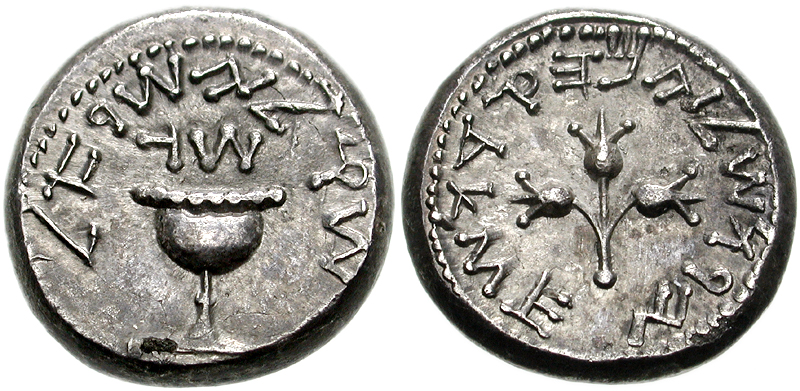
Exhibit · Cases I–III
The Mandate Pound
Palestine Currency Board · 1927–1948 · the visitor is asked to examine the Hebrew.
On 1 November 1927 the Palestine pound entered circulation; the Egyptian pound that had served since the British occupation remained legal tender beside it until 1 March 1928, when it was demonetized. The new currency was issued by the Palestine Currency Board, a body constituted in London by the Secretary of State for the Colonies. It was the only currency ever created for a territory named "Palestine" — and its Hebrew legend identified that territory as the Land of Israel. No second example of either has been recorded.3
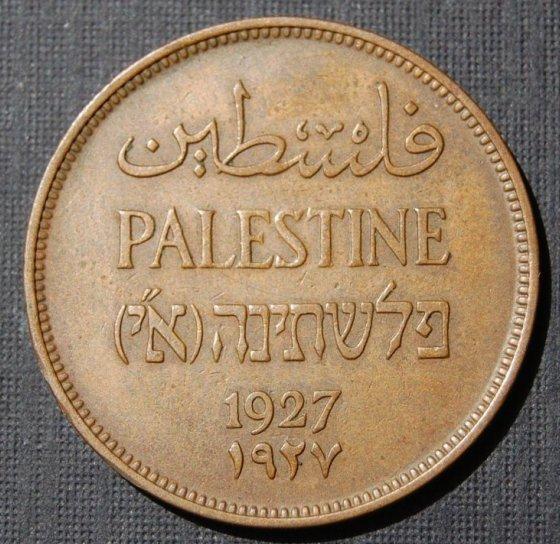
Specimen A. One mil, bronze, 1927. Languages: three. Issuer: the Palestine Currency Board, London.
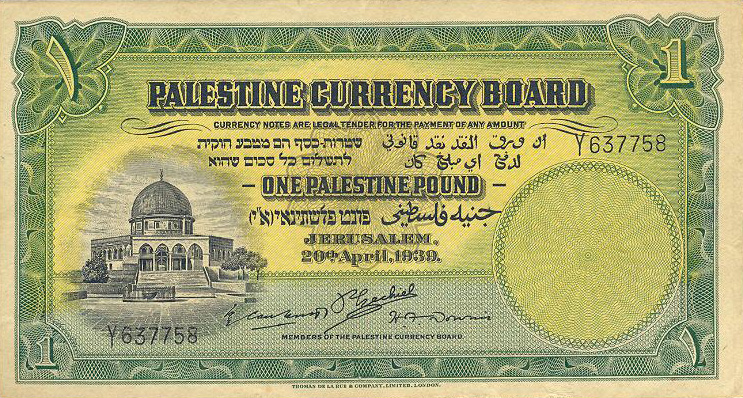
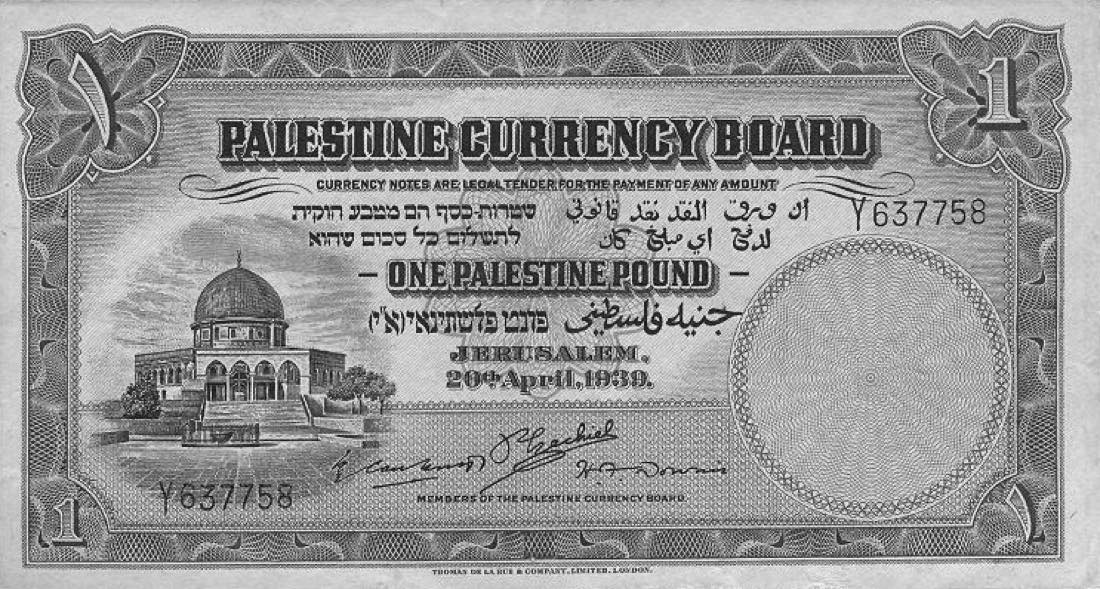
The only banknote series ever created for a territory named "Palestine." The territory's name appears three times, top to bottom: PALESTINE in English; فلسطين in Arabic; and, in Hebrew, פלשתינה (א״י) — the last expanding to "Palestine (Land of Israel)." Printed by Thomas De La Rue & Co., London. The two characters in parentheses are examined under magnification below.
Specimen B. One pound, paper, 1939. Printer: London. Issuer: London. Toponym: Palestine. Land: Israel.
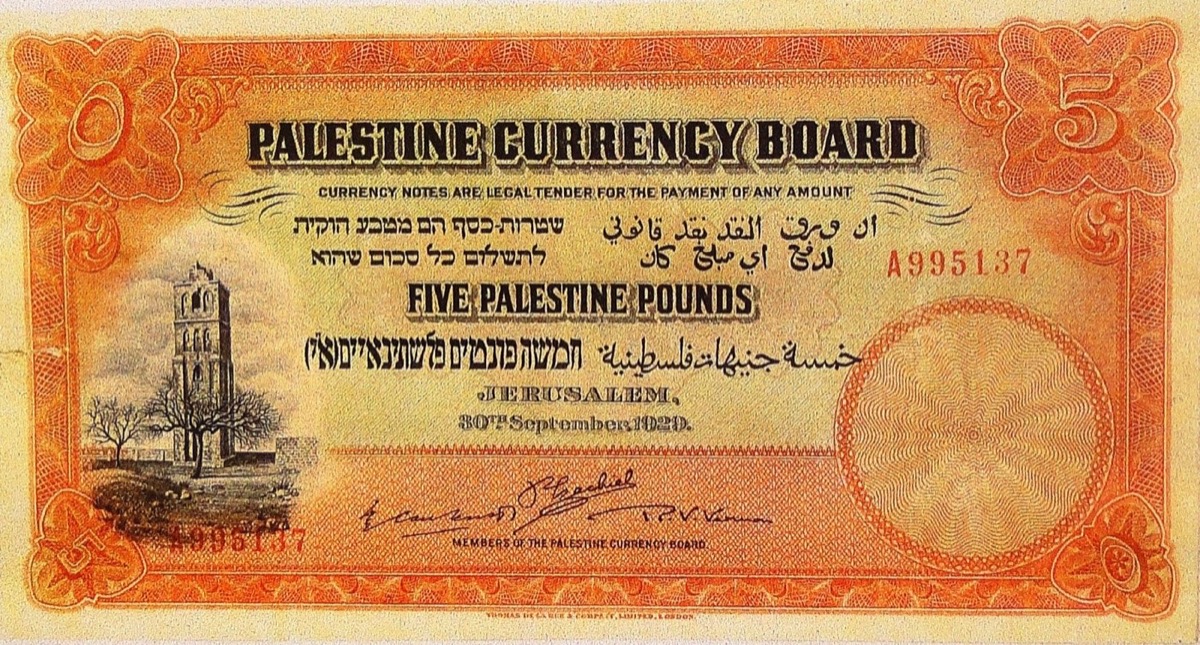
Specimen C. Five pounds, paper, 1929. Denomination: higher. Legend: identical.
Detail · Under Magnification
The Two Letters
Enlarged from the specimens above: the Hebrew legend of the Palestine pound.
Palestine Currency Board · All Issues · 1927–1948
פלשתינה (א״י)
"Palestine (Land of Israel)"
The two characters within parentheses — א״י — are the standard Hebrew abbreviation for Eretz Yisra'el, "the Land of Israel." The formula was fixed by the Mandatory administration in 1920 and applied without exception: every coin and note of the currency, every postage stamp, every passport of Mandatory Palestine carries it.
The two Hebrew letters were contested from the start. The formula was a compromise of 1920: Zionist representatives had asked that the country's Hebrew name be Eretz Yisra'el outright; Arab representatives objected to any mention of it, and petitioned throughout the Mandate for the abbreviation's removal. The administration declined both parties and printed the compromise on everything for the remainder of the Mandate.
The Board has reviewed the Arab objection and finds it well founded. The Mandate's own preamble committed Britain to a Jewish national home in Palestine. The coin said so. The coin was not lying.
The Balance
The Palestinian Issue
The ledger may now be balanced. Between 539 BCE and MMXXVI, the money of this territory was issued by Persia; by Macedon and its successor kingdoms; by a Jewish commonwealth and two Jewish revolts; by Tyre, Rome, and Byzantium; by three caliphates, a Crusader kingdom, and two sultanates; by Egypt; by Great Britain; and, concurrently at present, by Israel, Jordan, and the United States.
The number of currencies issued in that period by a sovereign Palestinian state is zero. The figure is consistent with the Institute's findings on governments, heads of state, and primary documents, and with the chronology in which they do not occur. Readers wishing to examine the method may consult the methodology.
- The only currency in 2,600 years to bear the name "Palestine" was administered from London. It identified the territory in Hebrew as the Land of Israel.
- The Paris Protocol (1994, Article IV) left the introduction of a mutually agreed Palestinian currency to continued discussion between the parties. The discussion continues. Daily commerce proceeds in shekels; property, in dinars; transfers, in dollars.
- A Palestine Monetary Authority has existed since 1994. It supervises banks, regulates payments, and publishes an annual report. It administers no currency; the Protocol did not provide one.
Accession Card · PHR-C-0001
Specimen D. Currency, sovereign, Palestinian. Issuer: none recorded. Status: not collected.
No Specimen Received
The Palestinian shekel, dinar, or pound has not yet been minted. The Editorial Office welcomes specimens.4