Room I · Antiquity to Mandate
Fourteen Empires.
Zero Palestines.
Three and a half thousand years of rulers, reviewed in order of appearance — who governed, from where, in what language. None of them, on inspection, turns out to be Palestinian.
Between 1550 BCE and 1948 CE, fourteen successive empires governed this territory: Egyptian, Assyrian, Babylonian, Persian, Ptolemaic, Seleucid, Roman, Byzantine, Arab, Crusader, Ayyubid, Mamluk, Ottoman, and British. None was Palestinian. The first administrative use of the word "Palestine" dates to 135 CE, a Roman renaming imposed after a Jewish revolt.
The Procession
The Corridor of Empires
Fourteen stations, in order of appearance. Each closes with the Review's verdict. Deliberation was brief.
From 1550 BCE to 1948 CE, fourteen empires governed this land1. Each kept records. The records survive. We have read them. In three and a half millennia, the word "Palestine" enters the administrative record four times2 — as a Roman punishment, a Byzantine filing convention, an Arab district heading, and a British colonial label. At no point does it enter as the name of a state.
Pharaohs governed Canaan from the Nile. Their diplomatic file — the Amarna correspondence, 382 cuneiform tablets in Akkadian — records the towns of the territory one by one; Jerusalem reports in as Urusalim. No one reports in from Palestine.
Verdict · No Palestine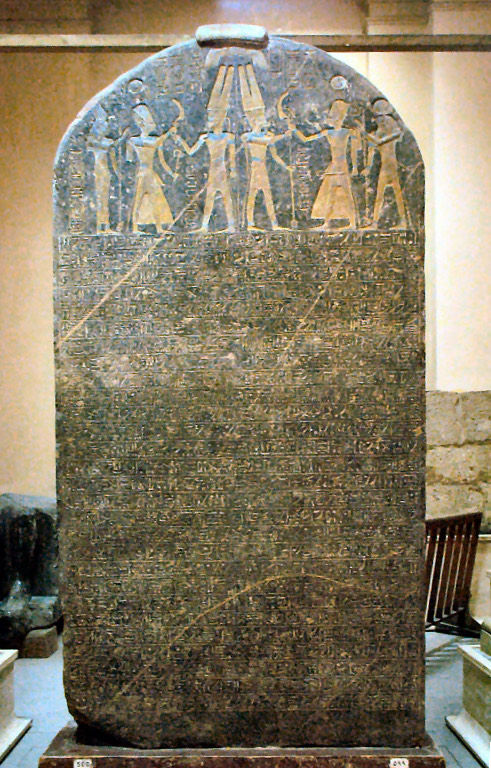
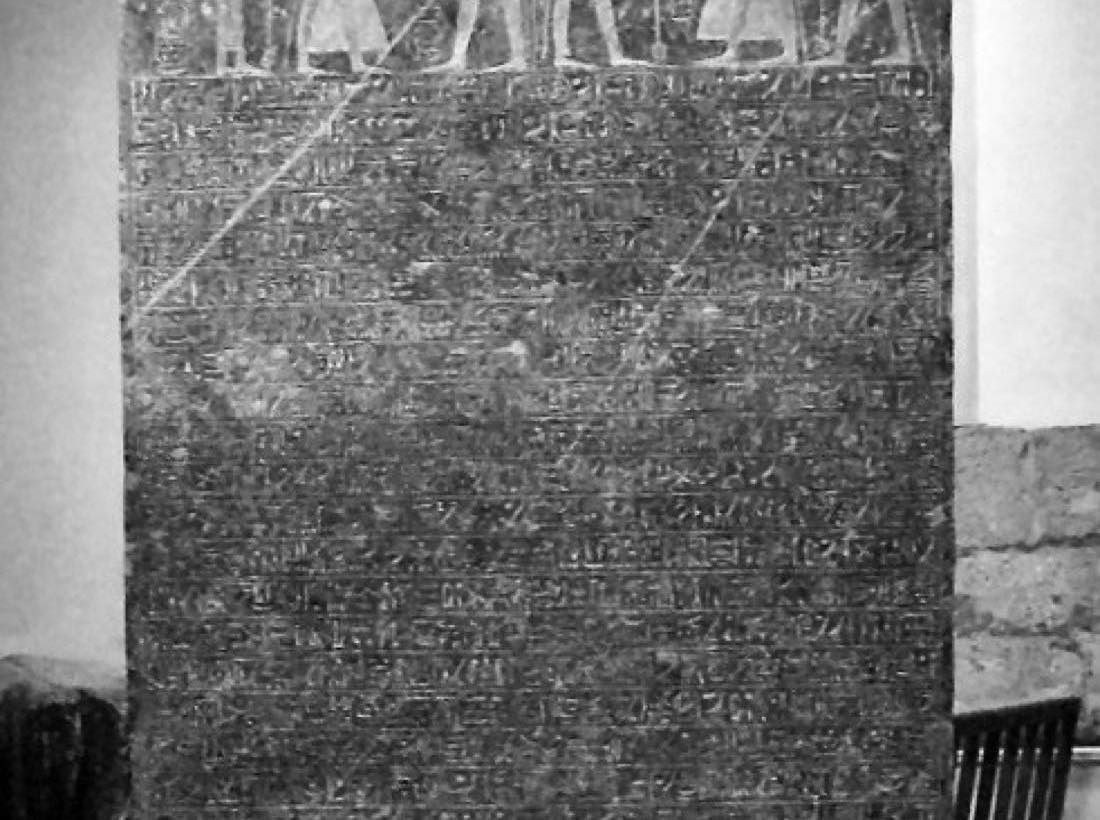
Specimen. Victory stele, granite, Egyptian, c. 1208 BCE. Mentions of Israel: one. Mentions of Palestine: none.
In the twenty-seventh line, the pharaoh Merneptah lists the enemies he claims to have annihilated. Among them is a people called Ysrỉꜣr — Israel. The hieroglyphic determinative identifies them as a people, not a place; the line reads, in translation, "Israel is laid waste; his seed is not." The boast was, in the longer view, premature.
This is the first mention of Israel in any document on earth. The first administrative use of "Palestine," at Hadrian's hand, occurs in 135 CE. The gap is one thousand three hundred and forty-three years. It has never been closed by a document recording a Palestinian state.
The Israelites built two kingdoms, governed from Samaria and Jerusalem, in Hebrew. Their coastal neighbours the Philistines — after whom everything would later be named — were Aegean immigrants, Mycenaean in origin, who vanish as an identifiable people centuries before the Arab conquest, leaving no linguistic or cultural line to today's Arab Palestinians. The connection is the spelling.
Verdict · No PalestineSargon II of Assyria, ruling from Nineveh, destroyed the Kingdom of Israel. Nebuchadnezzar of Babylon destroyed the Kingdom of Judah, burned the First Temple, and deported the Jews. Their annals, kept in Akkadian, name the conquered with bureaucratic care — Israel appears as Bīt-Ḫumri, the House of Omri. No Palestinian kingdom appears at all.
Verdict · No Palestine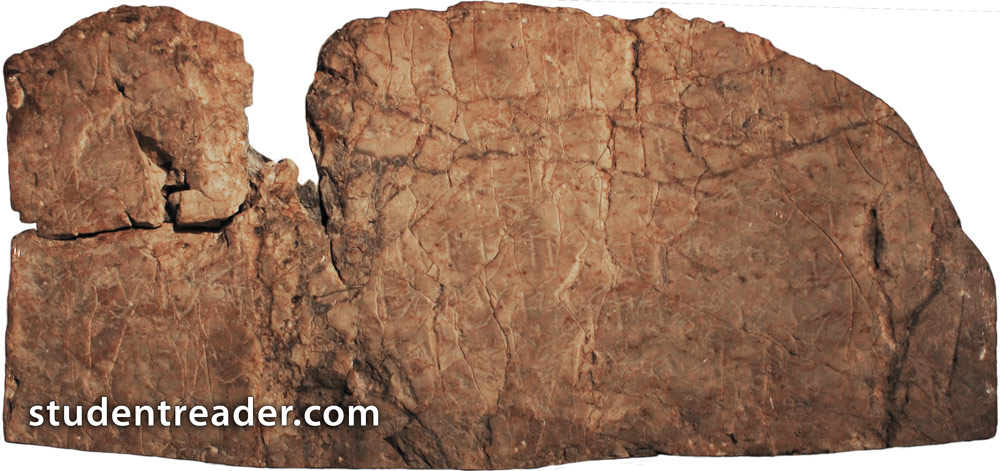
Specimen. Tunnel inscription, rock-cut, Judahite, c. 700 BCE. Language: Hebrew. Mentions of Palestine: none.
Six lines of Hebrew, carved at the point beneath Jerusalem where two teams of tunnellers, cutting toward each other from opposite ends, completed the water tunnel attributed to King Hezekiah. The text records the moment the teams heard each other's voices through the rock. It is a public-works report from the Kingdom of Judah. The annals at the previous station are in Akkadian; the city's waterworks are in Hebrew.
Cyrus the Great freed the Jews to return and rebuild the Temple. Persia governed from its capitals beyond the Euphrates, in Imperial Aramaic, and filed the territory under Eber-Nāri — "Beyond the River." The Behistun Inscription catalogues the provinces of the empire in three languages. Palestine is in none of them.
Verdict · No PalestineAlexander conquered; his generals divided. The Ptolemies governed from Alexandria and the Seleucids from Antioch, both in Greek, both filing the territory under Coele-Syria — "Hollow Syria." Two centuries of meticulous Greek administration attest no Palestinian polity.
Verdict · No PalestineThe Maccabean revolt against the Seleucids produced the only indigenous sovereign state this territory would see between the Babylonian Exile and 1948. It was governed from Jerusalem, by Temple priests, in Hebrew. Its name was Judea.
Verdict · Jewish statePompey annexed; Rome governed in Latin and Greek, naming the province Iudaea — Judea, the land of the Jews. In 135 CE, having crushed the Bar-Kokhba revolt, the Emperor Hadrian renamed the province Syria Palaestina, after the Philistines, the Jews' ancient enemies, to erase the Jewish connection to the land. This is the origin of the name as an administrative designation: imposed by a Roman emperor, in Latin, as a punishment — the word itself borrowed from the Greek geographers.
Verdict · The word arrives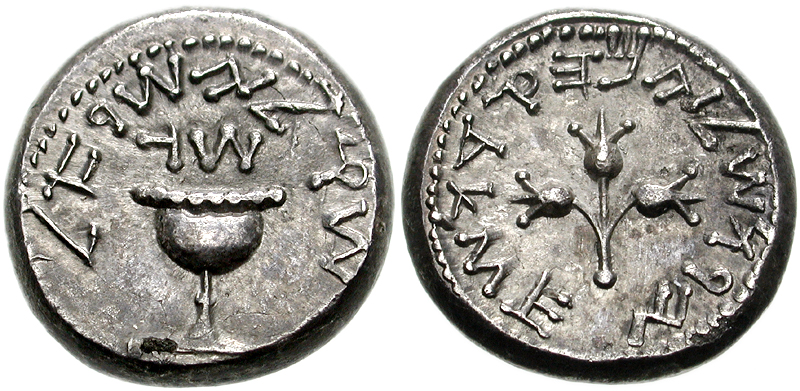
Specimen. Coin, silver, Jerusalem mint, 68/69 CE. Mentions of Israel: one. Mentions of Palestine: none.
Struck in Jerusalem during the revolt against Rome, dated by its own legend to year three — 68/69 CE. The obverse shows a chalice and reads, in Paleo-Hebrew script, Shekel of Israel; the reverse, around a stem of three pomegranates, Jerusalem the Holy (further specimens in the Currency collection). The coin does not mention Palestine. Neither, at that date, did the name of the province.
Christian Rome governed from Constantinople, in Greek, dividing the territory into three provinces — Palaestina Prima, Secunda, Tertia — under governors appointed from the capital. The name is Hadrian's, inherited with the filing system. A Palestinian nation appears nowhere in the file.
Verdict · No PalestineRashidun, Umayyad, Abbasid, Fatimid — four Arab empires governing in Arabic from Medina, Damascus, Baghdad, and Cairo, in that order. The military district here was Jund Filasṭīn: Hadrian's name, pronounced in Arabic. Its capital was Ramla, founded c. 715 — the only town the Arab empires founded in the territory. The inhabitants called themselves Arabs of Bilād al-Shām: Greater Syria.
Verdict · No PalestineFrench nobles governed the Latin Kingdom of Jerusalem in Old French and Latin. With them the name "Palestine" drops out of official use altogether; the kingdom was named for its capital. The chancery rolls list barons, knights, and burgesses. They list no Palestinians.
Verdict · No PalestineSaladin — a Kurd, born in Tikrit — retook Jerusalem for Islam. The Mamluks, slave-soldiers of Turkic and Circassian origin, held it after him, governing in Arabic from Cairo. Their map filed the territory under Safed, Gaza, and Karak. Palestine was not a heading they found necessary.
Verdict · No PalestineFour centuries of government from Constantinople, in Ottoman Turkish. The territory was filed first under the sanjaks of Jerusalem, Gaza, Nablus, Lajjun, and Safad, within the province of Damascus; in the Empire's final decades, as the mutasarrifate of Jerusalem with the sanjaks of Nablus and Acre. No Ottoman unit of any rank was named Palestine. The Empire then chose the losing side of a world war.
Verdict · No PalestineBritain governed from London, under a League of Nations mandate whose text directed it to establish a Jewish national home. The name "Palestine" returned to the map after an absence of eight centuries, and Article 22 of the Mandate made the official languages English, Arabic, and Hebrew. The coins, stamps, and passports accordingly read פלשתינה (א״י) — Palestine, Eretz Yisra'el: the Land of Israel. The era's "Palestinian" institutions — the Post, the Philharmonic, the airline, the football team — were Jewish (see Heritage). The Arab leadership rejected the term; its first congress had resolved the country "part of Arab Syria."
Verdict · Jewish national homeThe State of Israel was declared, governed from Jerusalem, in Hebrew. Jordan annexed the West Bank and Egypt occupied Gaza; in nineteen years of holding them, neither created a Palestinian state. Statehood was formally proposed in 1937, 1947, 2000, 2001, 2008, and 2020 — the Timeline keeps the scorecard. The answer, each time, was no.
Verdict · No Palestine1 The fourteen, for readers who wish to count: Egyptian, Assyrian, Babylonian, Persian, Ptolemaic, Seleucid, Roman, Byzantine, Arab (the Rashidun, Umayyad, Abbasid, and Fatimid caliphates, entered as one), Crusader, Ayyubid, Mamluk, Ottoman, and British. Counted by dynasty the total rises to seventeen. No method of counting produces a Palestinian entry.
2 The Review is aware of Herodotus, who in the fifth century BCE wrote of "the Syria called Palaistinē" — a Greek geographer's label for the district between Phoenicia and Egypt, then territory within a Persian satrapy (Histories 1.105, 3.91, 7.89). It describes a district, not a state, and is entered here in the interest of completeness. The Review is aware also of the earlier Egyptian Peleset (the Medinet Habu reliefs, c. 1175 BCE) and the Assyrian Palastu (the annals of Adad-nirari III, c. 800 BCE) — the Philistine coastal pentapolis: a people and a strip of shore, not a country, and not a state.
Curatorial file · Nomenclature
The Origin of the Word
In 135 CE the Emperor Hadrian crushed the Bar-Kokhba revolt — the third Jewish uprising against Rome. Jerusalem had already been refounded as a pagan colony, Aelia Capitolina, a temple of Jupiter rising where the Temple had stood — by Cassius Dio's account, a provocation of the revolt itself. After the suppression, the reprisal turned administrative: Jews were barred by decree from the city and its district, and the province of Iudaea — a name with the inconvenient property of describing its inhabitants — was renamed Syria Palaestina, after the Philistines.
That is the first administrative use of the word "Palestine" in history: a Roman emperor's deliberate erasure of the Jewish connection to the land. It is used today, in places, to insist upon precisely the opposite.
Between the Babylonian Exile and 1948 — a span of some 2,500 years — this territory produced exactly one indigenous sovereign state. The Maccabees took it from the Seleucid Greeks; Temple priests governed it from Jerusalem; its coins, in Paleo-Hebrew, name the High Priest "and the Council of the Jews" (specimens in the Currency collection). Its name was Judea.
The coinage names no Palestinian.
- The first documentary mention of "Israel" anywhere on earth predates the first administrative use of "Palestine" by 1,343 years.
- Hadrian's renaming of Judea was a reprisal for a Jewish revolt. The word "Palestine" entered official use as a punishment.
- Of fourteen administrations across three and a half millennia, exactly one was indigenous. Its language of government was Hebrew.
The Audit
A Closing Note
This is among the most thoroughly documented territories on earth. Fourteen administrations kept paperwork; archaeology has recovered it in quantity; the museums hold the artefacts and the libraries hold the texts. An absence of evidence is, in most fields, a weak argument. It gains considerably when the evidence is this complete and the absence is this consistent.
Across that record the word "Palestine" denotes, in turn, a Roman reprisal, three Byzantine provinces, an Arab military district, and a British mandate established expressly to host a Jewish national home3 — each imposed from a capital outside the territory, each a subdivision of somebody else's empire. For the eight centuries between the Crusader conquest and the British Mandate, no government here used the name at all. A registry of the Palestinian heads of state implied by all this is maintained in the National Leaders collection. It is current as of MMXXVI.
3 For the career of the name, see B. Lewis, "Palestine: On the History and Geography of a Name," The International History Review II (1980), 1–12. The name's history fills twelve pages. The state's, to date, fills none.
4 Readers who suspect the Review of insufficient diligence are invited to repeat the search in the Document Archives, which are open, indexed, and quick to consult.
Audit of the Procession
| Line item | Finding |
|---|---|
| Administrations reviewed | 14 |
| Languages of government | 9 |
| Indigenous sovereign states | 1 — Judea, governed in Hebrew |
| Sovereign Palestinian states | 0 |
The word "Palestinian," in three and a half millennia of records, identifies a sovereign nation on exactly zero occasions.