Room II · Political Institutions
The Empty Registry
The Review maintains a registry of the sovereign heads of state of Palestine, kept to the standards of the Almanach de Gotha. This room publishes it in full.
No sovereign Palestinian state appears in the historical record. Scored against the 1933 Montevideo Convention, the candidate meets 1 of 5 criteria. Recognition by 157 of 193 UN members has not altered the result. Mahmoud Abbas, elected in January 2005 to a four-year term, is in his twenty-first year of office; the last national election was held in January 2006.
A state, in the classical formulation of the 1933 Montevideo Convention, has four things: a permanent population, a defined territory, a government, and the capacity to enter into relations with other states. The scholarly literature customarily adds a fifth — independence from foreign control.
It will be useful to keep these in mind.
Wall Text · Ten Dates
A Short Chronology, in Bullets
- 1922. The League of Nations entrusts Palestine to Britain. The Mandate's own text commits it to a Jewish national home. The Crown is sovereign; the inhabitants, Arab and Jewish alike, carry its papers.
- 29 November 1947. The United Nations, by General Assembly Resolution 181, recommends two states, one Jewish and one Arab. The Jews accept. The Arabs decline and go to war.
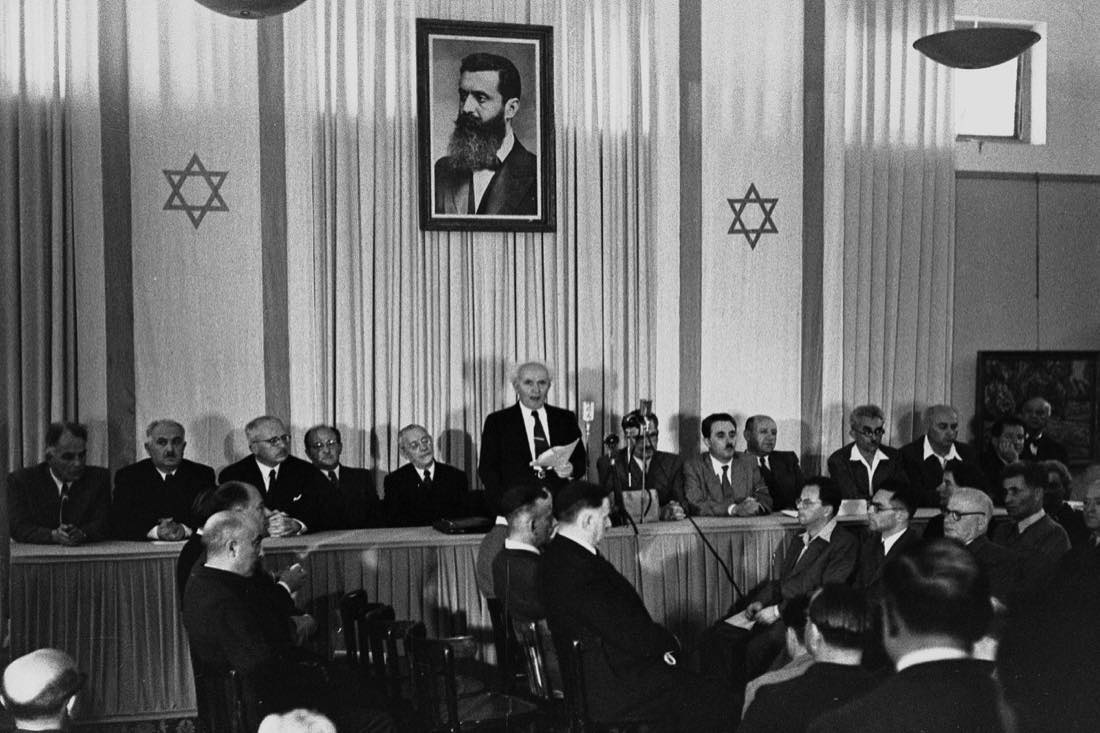
- 14 May 1948. Israel is proclaimed. The Arab state is not. Five armies invade; they lose.
- 22 September 1948. The Arab League proclaims an "All-Palestine Government" in Gaza City. It has no army, no currency, and within weeks no Gaza. It administers nothing from an office in Cairo until Egypt dissolves it in 1959.
- 1948–1967. Jordan annexes the West Bank; Egypt holds Gaza. Neither offers a Palestinian state. No Arab government demands one.
- 28 May 1964. The PLO is founded — three years before the war and the occupation it is said to resist. Article 24 of its charter disclaims the West Bank and Gaza. The article is reversed in 1968, once those territories are in Israeli hands and therefore worth claiming.
- 15 November 1988. Yāsir ʿArafāt reads a declaration of independence in Algiers. It creates no government, no army, no currency, no constitution, and no territory. It is a declaration.
- 1994. The Oslo Accords create the Palestinian Authority — by the Accords' own text, an interim administrative body and not a sovereign government.
- 2007. Hamas takes Gaza by force. The candidate state now has two governments, which is one more than it has states.
- MMXXVI. Maḥmūd ʿAbbās, elected in 2005 to a four-year term, is in his twenty-first year of office.
The Centrepiece
The Registry
We arrive at the room's purpose. The Review maintains, after the manner of the Almanach de Gotha and the Statesman's Yearbook, a registry of the sovereign heads of state of Palestine. The conventions are the ordinary ones. An entry requires a name, the dates of accession and departure, and the state. Candidate entries are verified against coronation rolls, oaths of office, instruments of succession, and the diplomatic lists of the receiving capitals — the same tests that admit kings of Jordan and presidents of Israel without difficulty. The registry was opened in 1948, the first year such a state could have existed, and has been kept continuously since.
It is reproduced below in its entirety.
| № | Name | Reign | Method of Accession | Notes |
|---|---|---|---|---|
| No Entries Recorded | ||||
The Examination
The Montevideo Examination, Scored
We return to the checklist with which this room opened, and which our methodology obliges us to apply without favour. The Convention sets out the qualifications of statehood in its first article; the literature adds independence as a fifth.1 The candidate is scored below.
I · A permanent population. Present, permanent, and undisputed. The criterion is met — being the one that requires no state to meet it. The Convention wraps the remaining four criteria around that population; it is there the audit encounters difficulty. Met: Yes.
II · A defined territory. No border of a Palestinian state has ever been agreed or demarcated. The Algiers declaration of 1988 names none. Jurisdiction on the ground is an archipelago — Areas A and B, roughly 40 per cent of the West Bank — with Gaza under separate management since 2007. Met: No.
III · A government. Two, which is the same deficiency approached from the other side. Neither has faced the voters since 2006; the legislature was dissolved by court order in 2018, eleven years after it last met. Met: No.
IV · Capacity to enter into relations with other states. Contracted away. Under the Interim Agreement of 1995, the Palestinian Council "will not have powers and responsibilities in the sphere of foreign relations."2 Met: No.
V · Independence (the customary fifth). The candidate's principal revenues — customs duties and import VAT — are collected by Israel and remitted monthly under the Paris Protocol.3 The Review is unaware of another candidate state whose treasury arrives by transfer from the state it disputes. Met: No.
Criteria Met — 1 of 5
The Editorial Board has checked the arithmetic twice.
The Control Group
The Control Sample: Three States, Timed
A null result is only as good as its baseline. The audit therefore records, as its control sample, the speed with which states that do exist generate the ordinary paperwork of existence — a seat, a currency, an election. Three cases suffice: the candidate's two nearest neighbours, and the youngest state on record.
| State | Independent | Own currency | Further paperwork |
|---|---|---|---|
| South Sudan | 9 July 2011 — a Saturday | Banknotes circulating 18 July 2011 — nine days4 | Admitted to the United Nations 14 July 2011 — five days |
| Israel | 14 May 19485 | Anglo-Palestine Bank notes issued 18 August 1948 — fourteen weeks, in wartime | First general election 25 January 1949 — eight months; turnout 86.9 per cent |
| Jordan | 25 May 1946 | Dinar established by law, 19496 | Dinar sole legal tender from 30 September 1950, retiring the Palestine pound |
| The candidate | Pending since 1948 | None recorded | See Registry № 1, above |
The control behaves as a control should: wherever a state exists, the instrument detects it promptly, in units of days and weeks. South Sudan, independent on a Saturday, had its own money the following week. Registry № 1 has been open since 1948.
The Audit
The Mandate Made Two States. The Larger One Is Called Jordan.
Treat the Mandate for Palestine as an estate, and audit it. The territory entrusted to Britain in 1922 ran from the Mediterranean to the desert frontier of Mesopotamia — roughly 120,000 square kilometres, on both banks of the Jordan River.
Article 25 of the Mandate, inserted at British insistence, authorised the Mandatory "to postpone or withhold" the Jewish-national-home provisions east of the river. The Council of the League approved its application in September 1922 — Winston Churchill, as Colonial Secretary, having already installed the Hashemite emir ʿAbdullāh bin Ḥusayn at Amman in March 1921. The eastern parcel was renamed Transjordan. In 1946 it became the Hashemite Kingdom of Jordan.
| Portion | Disposition (1922) | Today | Share |
|---|---|---|---|
| East of the Jordan | Severed under Article 25; placed under the Hashemite emir | Hashemite Kingdom of Jordan | ~78% |
| West of the Jordan | Retained as "Palestine"; national-home provisions applied | State of Israel; West Bank; Gaza | ~22% |
The audit, in round numbers: of an estate of roughly 120,000 square kilometres, approximately 91,000 — seventy-eight per cent — went east, and is today a sovereign state with a seat at the United Nations, a currency, postage, and a national football team. Its population is Palestinian in origin by estimates ranging from half to two-thirds; the Kingdom does not publish the figure. The late King Hussein dispensed with the range in December 1981, telling the Arabic weekly al-Nahār al-ʿArabī wal-Duwalī that "Jordan is Palestine and Palestine is Jordan." His Majesty later revised the finding; the demography did not.
The remaining parcel, west of the river, is the territory over which the entire conflict has since been conducted. The Review records the finding in the standard form: the larger share of the estate already constitutes an Arab state whose population is between half and two-thirds Palestinian in origin. Every contemporary discussion of Palestinian statehood concerns the 22 per cent.
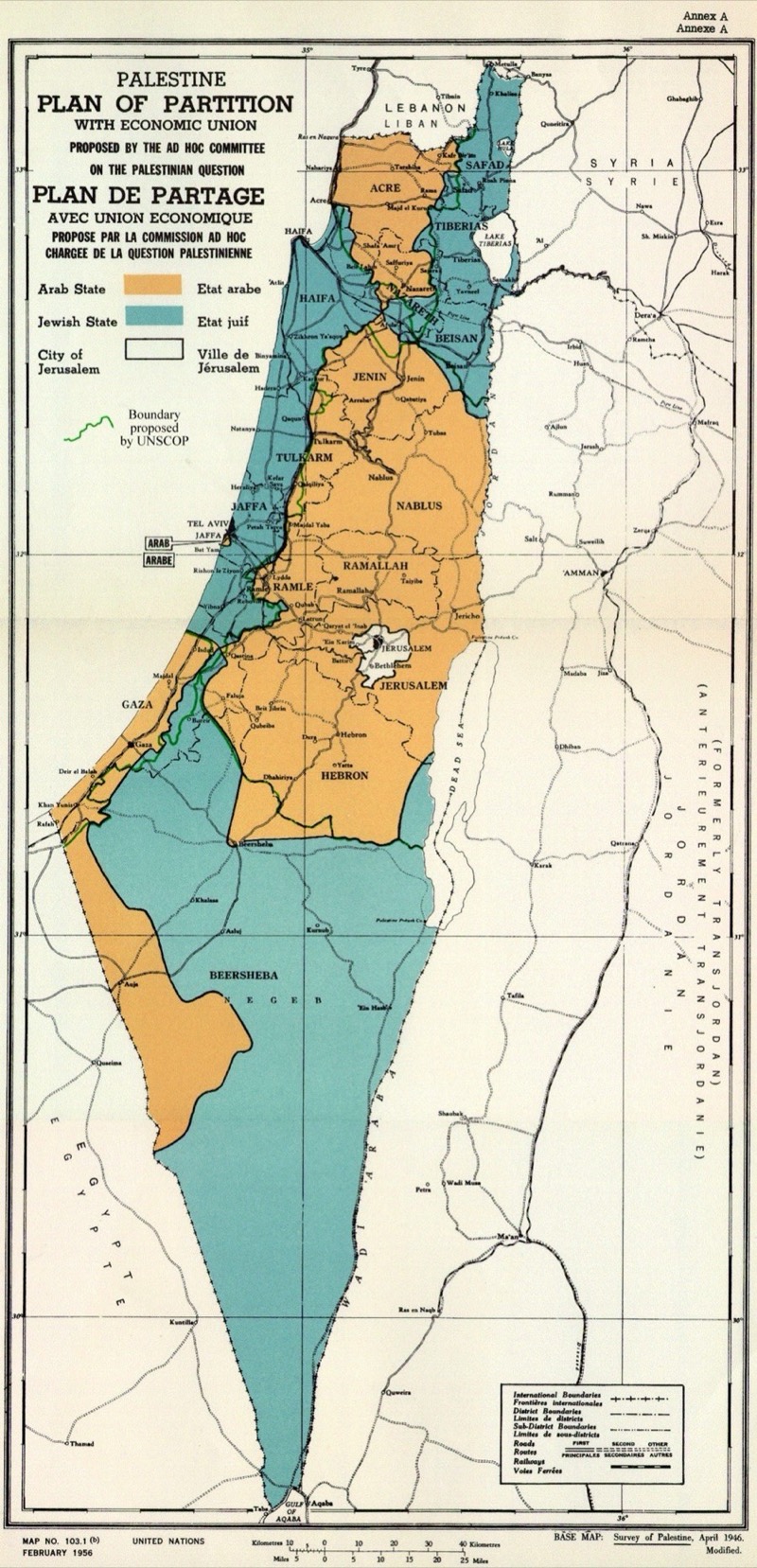
The 78 per cent does not come up.
The Annex
For Comparison: Persons Who Have Claimed Authority
The registry's condition is not for want of applicants. The following persons have, since 1948, claimed administrative authority over some portion of the territory; several are also sought by the National Portrait Gallery, which reports lighting issues of its own. The right-hand column is supplied for completeness. It does not vary.
| Name | Office Claimed | Years | Held Territory | Sovereign? |
|---|---|---|---|---|
| Ḥajj Amīn al-Ḥusaynī | "President," All-Palestine Government | 1948–1959 | None. Lived in Cairo. | No |
| Aḥmad al-Shuqayrī | Chairman, PLO | 1964–1967 | None. Beirut. | No |
| Yāsir ʿArafāt | Chairman PLO; later President of PA | 1969–2004 | Tunis, then Gaza/Ramallah (PA jurisdiction) | No |
| Maḥmūd ʿAbbās | President of the PA · Chairman of PLO | 2005 → present (Year 21 of a 4-year term) | Areas A & B of the West Bank (~40%) | No |
| Ismāʿīl Haniyya | Head, Hamas Political Bureau | 2017–2024 | Gaza (de facto, by force) | No |
| Yaḥyā al-Sinwār | Head of Hamas in Gaza | 2017–2024 | Gaza (de facto) | No |
Article 36 of the Palestinian Basic Law sets the President's term at four years. Maḥmūd ʿAbbās was elected on 9 January 2005, with 62.5 per cent of the vote. The term expired on 9 January 2009.
He remains in office. The parliament that might have raised the matter was dissolved by court order in December 2018, having last met in 2007; the court required elections within six months. Elections were at length called for 22 May 2021, with a presidential vote to follow in July, and postponed indefinitely three weeks before the first, the question of East Jerusalem's ballot boxes being cited. No presidential or parliamentary vote has been held since January 2006. A decree of February MMXXVI has, however, scheduled elections — for the Palestinian National Council, in November. The Review will report the result.
The term was four years. This is the twenty-first.
From the Collection
Exhibit: The Mandate Passport
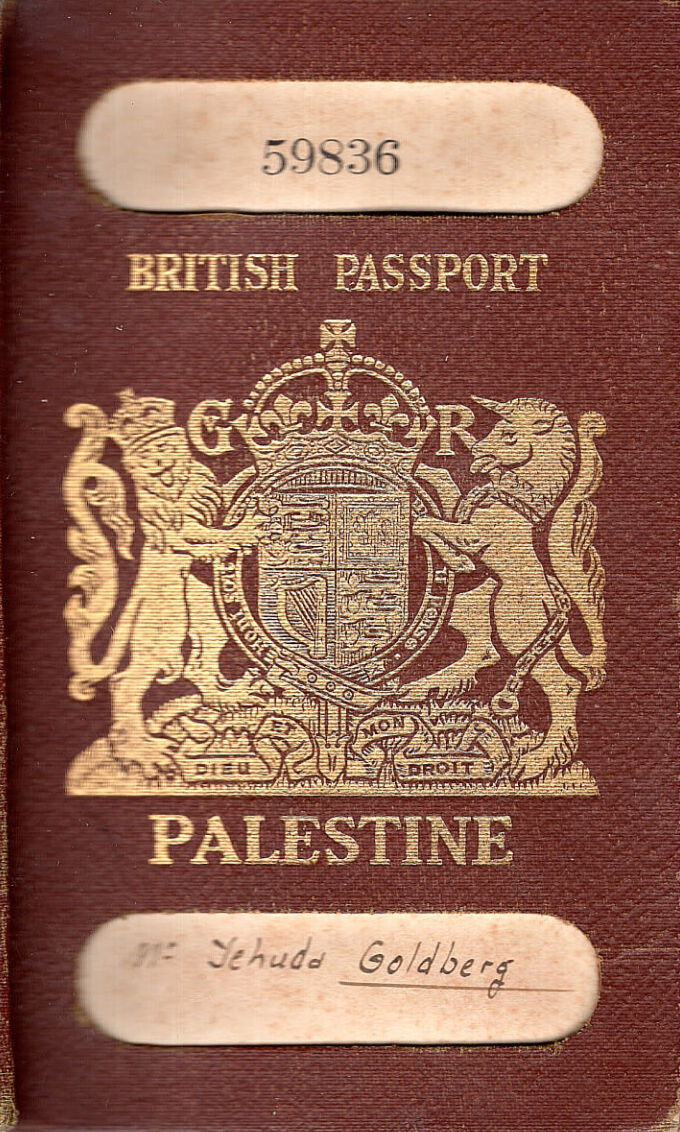
The registry above stands empty; the collection does, however, hold papers of an actual Government of Palestine. They were issued by Britain. The cover gives the issuing authority in three languages: the English reads Government of Palestine; the Arabic reads حكومة فلسطين; the Hebrew reads ממשלת פלשתינה (א״י) — "Government of Palestine (Land of Israel)." The same parenthetical appears on the Mandate's coins and banknotes, catalogued in the currency collection.
This is the document under which Chaim Weizmann, David Ben-Gurion, Levi Eshkol, Golda Meir, and Shimon Peres travelled and were identified as Palestinians. Peres applied for Palestinian citizenship in 1937, aged fourteen. Each of them was Palestinian until 14 May 1948 — at which point they ceased to be Palestinian, and Palestinians ceased to mean them.
Closing Note
A Closing Note on State Institutions
- Statehood was offered in 1937, 1947, 2000, 2001, 2008, and 2020; with the Gaza withdrawal of 2005 and the Khartoum reply of 1967, the count reaches eight. The scorecard records the replies.
- The last Palestinian national election was held in January 2006. The next presidential or legislative vote has no date.
The State of Palestine has a flag, an anthem, a website, observer status at the United Nations (Resolution 67/19 of 29 November 2012), and recognition, as of September MMXXV, from 157 of the organisation's 193 member states. These are real, and none of them appears on the Montevideo checklist. What does appear there — territory controlled, a population governed, a government independent of foreign powers, the capacity to bind itself abroad — is precisely what the archives cannot produce, and not for want of searching.
In September MMXXV several member states, the United Kingdom, France, Canada, and Australia among them, extended recognition. The Review re-verified the registry upon each announcement. Article 3 of the Montevideo Convention — the instrument the announcements invoke — provides that the political existence of the state is independent of recognition; the Review applies the article evenly. What recognition did not supply, then or since, is an agreed border, a single government, an election, or a currency. The registry's condition is unchanged. It remains open.
What the record offers instead is a registry in pristine condition and a president in year twenty-one of a four-year term.